Health SystemsOctober 2026 | Issue 01 | Perspectives
Right Expert, Right Question
Powering India's Health Transition
Why India's health transition needs the right specialist on the right question at the right moment, and how connecting expertise to ambition turns plans into results.
By Geethanjali M · Founder and CEO, NirvaNex
1 October 2026 · 7 min read
Imagine a Monday morning in a state health department. One programme lead is reviewing a plan to strengthen newborn care. A colleague down the corridor is weighing a proposal for a new digital platform. A funder has just asked for an investment case on noncommunicable disease control, and the weather forecast raises fresh questions about heat and vector borne illness. That makes four decisions, four kinds of expertise, and one team with one week.
Scenes like this are becoming the everyday reality of Indian public health. They are also a sign of progress. A country does not face questions this sophisticated unless it has already travelled far.

01 A country living several transitions at once
Public health thinkers have long described an epidemiological transition, in which societies move from a burden dominated by infection and undernutrition toward one shaped by chronic disease and injury1. India is living this transition in a particularly rich way. Unfinished priorities in maternal, newborn, child, and nutrition health continue alongside rising noncommunicable disease, mental health needs, and climate sensitive illness. The pace differs from state to state, so India is better understood as a set of nations within a nation, each at its own point on the curve2.
That diversity is a strength. It also means that no single national template can serve every state equally well.
02 The direction is set. The frontier is execution.
The destination is clear. The Sustainable Development Goals set a shared global horizon, with universal health coverage at its heart3. The National Health Policy places assurance, quality, and equity at the centre of national ambition4. NITI Aayog's work on health systems reform points to a powerful insight: fragmentation across financing and service delivery is among the greatest barriers to performance, and integration is among the greatest opportunities5.
When direction is this clear, the question changes. It moves from "where are we going?" to "how do we get there, state by state, institution by institution, and rupee by rupee?" That is a technical question, and it deserves technical depth.
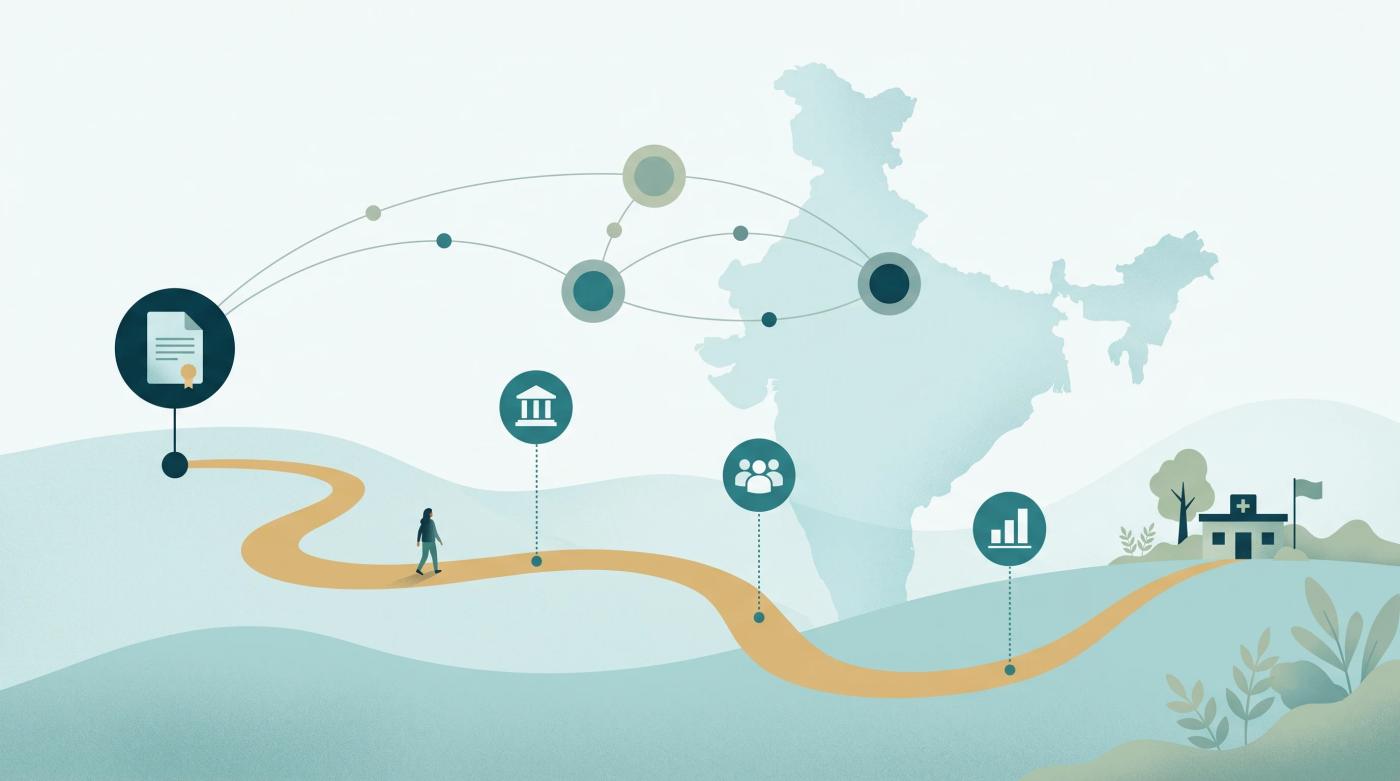
03 Four steps that carry a plan to results
The most successful large scale efforts in any sector tend to follow a recognisable arc. In health, it looks like this.
- 1DiagnoseRead burden, coverage, equity and system readiness across states
- 2DesignShape priorities, investment cases and plans informed by specialised depth
- 3DeliverBuild the capability that turns a plan on paper into practice
- 4DemonstrateShow results through credible, independent learning
Diagnose. Every good plan begins with an honest reading of burden, coverage, equity, and system readiness. Strong analytics turn routine data into insight, and comparison across states shows where the greatest headroom lies2.
Design. This is where specialised expertise changes outcomes. Health economics guides priority setting, essential packages, and investment cases, helping decision makers choose where each rupee does the most good6, 7. Digital health enterprise planning goes well beyond choosing software. It shapes architecture, interoperability, governance, and sustainability, which decide whether technology strengthens a system or adds to its fragmentation8. Climate and human health expertise brings heat, air quality, water, and vector patterns into service planning9. Quality of care frameworks make sure that wider access becomes better health, since the two are not the same thing10.
Health economics
Priority setting, essential packages and investment cases
Digital health enterprise planning
Architecture, interoperability, governance and sustainability
Climate and human health
Heat, air quality, water and vector patterns in service planning
Quality of care
Turning wider access into better health outcomes
Deliver. A good design succeeds when teams can carry it out. Implementation research shows that context, sequencing, and local capability shape results as much as the intervention itself11, 12. Here, capacity building for programme managers and frontline teams turns a plan on paper into practice on the ground.
Demonstrate. Credible monitoring, evaluation, research, and learning, ideally with independent validation, builds trust among governments, funders, communities, and institutions. It also feeds lessons back into the next cycle of decisions10, 12.
No programme team, however committed, can hold every one of these capabilities in house at every moment. It should not have to.
04 Money is moving, and so is the map
India's health investment picture is diversifying. Public budgets remain the anchor. Corporate social responsibility commitments, philanthropic capital, and institutional partnerships increasingly shape what is built and sustained. Each brings energy and flexibility, and each asks the same question: where will the next rupee create the greatest health return?
Investment thinking has long shown that priorities, costs, and sequencing matter enormously, and that well chosen investments can deliver extraordinary returns6, 7. Costed plans, clear investment cases, and transparent results frameworks help governments direct resources to high value areas. They also help funders see how their contribution fits into the larger system. In a period of rising and diversifying investment, this planning capability becomes a national asset.
05 The connection advantage
India is fortunate to hold a vast pool of talent: economists and epidemiologists, technologists and nutrition scientists, climate researchers, clinicians, and programme leaders, spread across universities, research bodies, civil society organisations, and public institutions.
The ecosystem has never lacked expertise. What shapes success is the quality of the match.
Success depends on the right specialist, with the right depth, engaged on the right question at the right moment, within a clear mandate.
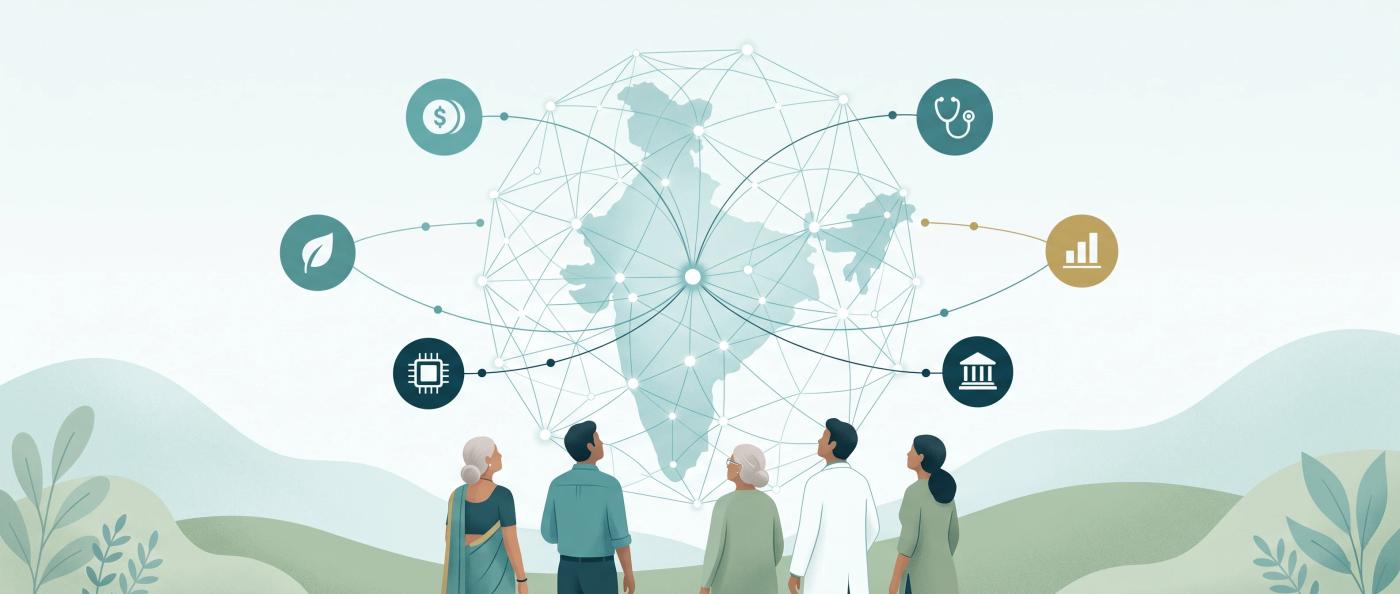
Imagine that connection working well. A civil society organisation finds the economist who sharpens its investment case. A state team meets the digital architect who spares it a costly dead end. A research institution finds a delivery partner for its evidence. Across hundreds of such connections, India gains something like a distributed think tank, bringing independent, specialised thinking to many decision points at once and carrying lessons from one state to the next.
06 What changes when expertise is connected
Plans become sharper and more locally fitted. Investment choices become more transparent and defensible. Learning travels faster across states and institutions. Accountability toward national goals and the SDGs becomes easier to demonstrate. Above all, India's remarkable reservoir of talent and capital goes further.
India's health transition is a moment of real opportunity. The nations that make the most of such moments tend to be the ones that connect their expertise to their ambition early. India is well placed to do exactly that.
References
- Omran AR. The epidemiologic transition: a theory of the epidemiology of population change. Milbank Mem Fund Q. 1971;49(4):509 to 38.
- India State Level Disease Burden Initiative Collaborators. Nations within a nation: variations in epidemiological transition across the states of India, 1990 to 2016 in the Global Burden of Disease Study. Lancet. 2017;390(10111):2437 to 60.
- United Nations. Transforming our world: the 2030 Agenda for Sustainable Development. A/RES/70/1. New York: United Nations; 2015.
- Ministry of Health and Family Welfare, Government of India. National Health Policy 2017. New Delhi: MoHFW; 2017.
- NITI Aayog. Health Systems for a New India: Building Blocks. Potential Pathways to Reforms. New Delhi: NITI Aayog; 2019.
- Jamison DT, Summers LH, Alleyne G, Arrow KJ, Berkley S, Binagwaho A, et al. Global health 2035: a world converging within a generation. Lancet. 2013;382(9908):1898 to 955.
- Jamison DT, Gelband H, Horton S, Jha P, Laxminarayan R, Mock CN, et al, editors. Disease Control Priorities: Improving Health and Reducing Poverty. 3rd ed. Washington (DC): World Bank; 2017.
- World Health Organization. Global strategy on digital health 2020 to 2025. Geneva: WHO; 2021.
- Watts N, Adger WN, Agnolucci P, Blackstock J, Byass P, Cai W, et al. Health and climate change: policy responses to protect public health. Lancet. 2015;386(10006):1861 to 914.
- Kruk ME, Gage AD, Arsenault C, Jordan K, Leslie HH, Roder DeWan S, et al. High quality health systems in the Sustainable Development Goals era: time for a revolution. Lancet Glob Health. 2018;6(11):e1196 to e1252.
- Damschroder LJ, Aron DC, Keith RE, Kirsh SR, Alexander JA, Lowery JC. Fostering implementation of health services research findings into practice: a consolidated framework for advancing implementation science. Implement Sci. 2009;4:50.
- Peters DH, Adam T, Alonge O, Agyepong IA, Tran N. Implementation research: what it is and how to do it. BMJ. 2013;347:f6753.